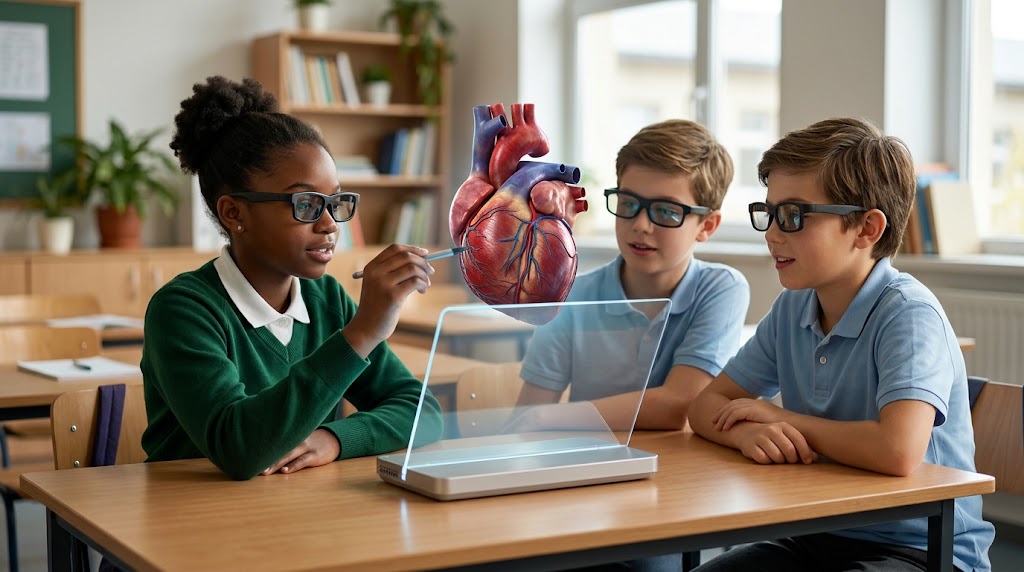
From Digital to Spatial: How AI Is Changing the Economics of Immersive Learning
Spatial learning has never suffered from a shortage of compelling use cases. Anatomy, chemistry, engineering and many other subjects are inherently three-dimensional (3D), yet students are still often asked to learn and understand them through text, two-dimensional diagrams or flat video. The main obstacle has been economics: creating enough high-quality interactive 3D content to cover an ordinary curriculum that has traditionally required specialized artists, developers and considerable… [...]
Rating
Innovation
Pricing
Technology
Usability
We have discovered similar tools to what you are looking for. Check out our suggestions for similar AI tools.
5% GPU utilization: The $401 billion AI infrastructure problem enterprises can't keep ignoring
For the last 24 months, one narrative justified every over-provisioned data center and bloated IT budget: the GPU scramble. Silicon was the new oil, and H100s traded like contraband. Reserve capacity [...]

Google’s ‘Nested Learning’ paradigm could solve AI's memory and continual learning problem
Researchers at Google have developed a new AI paradigm aimed at solving one of the biggest limitations in today’s large language models: their inability to learn or update their knowledge after trai [...]
MIT's new fine-tuning method lets LLMs learn new skills without losing old ones
When enterprises fine-tune LLMs for new tasks, they risk breaking everything the models already know. This forces companies to maintain separate models for every skill.Researchers at MIT, the Improbab [...]
Sony's XYN XR headset is being used in very different ways at CES 2025
At CES last year, Sony teased an AR/VR headset prototype focused on “spatial content creation.” And at the same time, Siemens announced it was working with Sony to use that same hardware, includin [...]
The AI compute gap: Enterprises are buying infrastructure faster than they can measure what it costs
Across 107 enterprises, AI infrastructure spending is accelerating well ahead of the ability to see or steer its economics. Most organizations run their AI on a familiar base of hyperscalers and model [...]
Apple Vision Pro users can check out a short, immersive Metallica concert film this week
Apple and Metallica have teamed up to bring a free, immersive experience from one of the band's concerts to Apple Vision Pro. Starting on March 14, owners of the headset will be able to watch liv [...]